Home Blog

Thoughts from Berlin

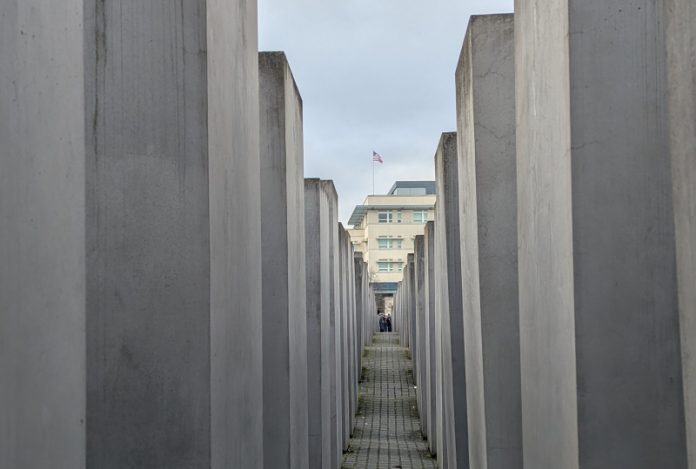
The American flag flies over the American embassy in Berlin, across the street from the Holocaust memorial.

Visiting Berlin on a Europe trip, I’m confronted head-on with many of the topics I’ve been grappling with for months.

Meeting Germans, some of the nicest and most open-minded people I’ve met, in a city steeped with culture. Knowing that they had a similar reputation before they started two World Wars and killed tens of millions of people.

Coming off a leg of the trip that involved spending time with my close-minded and supremacist parents, surrounded by similarly-minded Israelis, all steeped in their own versions of propaganda, misinformation, and fundamentalist beliefs.

As a child, I was raised to believe that there was Good and there was Evil. Esau hates Jacob. Germany is biblically ordained to hate Jews. We don’t visit Germany. We don’t buy German products. Boycott, divest, sanction.

I have since learned that Jews can create their own genocides, their own mass-murders, and their own propaganda. That they can build their own walls. That they can justify their actions with the need for more living space.

I have since learned that nobody sets out to fight against evil that is not at their doorstep. America did not join the war to liberate the camps or fight Nazis. I know this because they stayed neutral for as long as possible and because they seem quite comfortable harboring both Nazis and their own deeply entrenched racist beliefs.

I also recognize that no one would come to save the Jews if they were being oppressed in another country, just as no one is coming to save the Palestinians and no one is coming to save the Ukrainians.

***

I met a woman in Berlin, Sofiya. Originally from Russia, she fled to Berlin with her husband after Russia invaded Ukraine, so he could avoid the draft. She told me she actually had Israeli citizenship as well – automatically granted by the Israeli government because her father was Jewish. She joked that she was collecting shitty citizenships.

I shared with her how I am ashamed of telling people I’m from Israel. She commiserated. She feels the same about telling people she’s Russian, she said, especially since Germany has many Ukrainian refugees. Shitty citizenships indeed.

***

Evil, points out Hannah Arendt, is not a complex or deep-rooted thing.

It is not spiritually predestined, as my father would have us all believe.

It is quite easy to foster, as can be seen in America’s devolution into totalitarianism in a matter of months.

Arendt was simultaneously supportive of the need for Jewish self-defense, and critical of partitioning Israel and the dangers of creating a nation-sate.

***

I was reading about Eli Wiesel and his outspoken advocacy for human rights (and for illegal settlements in Jerusalem, citing the bible as justification). How, when Israel was going to host a forum about the Armenian Genocide, Turkey got angry, threatened Turkish Jews, and Israel did everything in its power to shut down the conference.

Wiesel withdrew his participation and encouraged others to do the same because, as he said, “One life is more important than anything we can say about life.” I hear his point. I only wonder what would his, and the state of Israel’s, stance be if the conference they were pressured to cancel was one about the Holocaust.

All I ask is for consistency.

The more civilized Berlin presents itself as, and the more unhinged my family, Jewish friends, and conservative Americans become, the more the ground upon which my mind tries to establish a basic sense of equilibrium and safety, crumbles.

I tried visiting the Holocaust Museum in Berlin, but it was closed for renovations.

Negativity

Last week during my therapy session, I had the sudden instinct to share my upbringing with my therapist in an unusual way – I pulled up Google street view in maps and showed her the school buildings I had attended and neighborhood I had grown up in.

I was surprised at how emotional I got, I started crying within a few seconds of pointing out the first school building.

“You can’t see the room I was in for first grade, because it’s below ground,” I finally found the words. “There were two windows for the classroom that opened to a courtyard below street level.”

“It looks like a prison,” she observed. “Why are there bars everywhere?”

I explained it was to keep the kids in and the terrorists out – every school in Israel has an armed security guard. “I’m not sure which of those two was the priority here, but I suspect it was the kids.”

Whereas Google regularly updates street view in other parts of the world, the footage hasn’t been updated since 2011. It’s as if Google doesn’t want to go back there either.

“I happen to know the building looks even worse now,” I told her. “They’ve put tarps over the bars so you can’t even see through them.”

I continue the tour, showing her all three buildings where I spent 11 years of my life.

“This was where the community garbage room used to overflow, and trash would pile up right to the door of the school building.”

I showed her the window I sat beside, in 8th grade. It was covered in steel mesh, further contributing to the prison chic aesthetic. “But the window pane was broken, and during the winter I froze when I sat there. I ended up getting pneumonia.”

I showed her the kids crowding around the camera that was capturing all this. How we’d just empty out into the street and roam aimlessly during recess. How there were almost no trees or grass or any greenery.

“It all looks hard,” she observed. “Stone and cement.”

I showed her all the narrow alleys and tunnels, shrouded in shadows. How the houses were so close to each other that there wasn’t enough light even through the windows.

“Whenever I imagine the neighborhood I grew up in, I just imagine darkness.”

She had never seen anything like this, she said. Amanda from Newfoundland did not have context for Zilbermans or the Jewish Quarter.

I feel like I am endlessly showing. Telling. Explaining. Yet nothing I say can do justice to the darkness in my mind, the bars around my psyche. This Google Street View was another attempt.

“It feels oppressive,” she observed.

Did it land for me? Her words, her mirroring back to me what she was seeing? Not really. Maybe a little. Maybe nothing can. I guess the crying was a good sign, if nothing else.

I showed her the Muslim Quarter. How suddenly an imaginary line gets crossed and you’re in a mystical Arab bazaar, where you need to be worried for your safety and where plaques commemorate victims of past stabbings.

“Is it any wonder,” I concluded. “That I am so bitter? That I see the world in such a negative light?”

That was the theme of that week’s session. My negativity. Why can’t I see things more positively? Appreciate people’s efforts, or their partial successes? Why, my partner had recently asked, could I not mefargen – the modern Hebrew word that has no exact translation but which I roughly interpret as “adopt benevolent positivity towards others”?

Why indeed.

The answer, my subconscious informed me, was how bleak my childhood was. How black and white, but mostly black.

“It feels like a pressure on my brain,” I described it. “Like I am not allowed to think in certain directions. Like there’s a filter through which everything gets viewed, not as dark-colored glasses, but like a dark cloud between my eyes and my mind.”

I literally did not know what positivity looked like, even though at this point I was ready to adopt it.

“I can see all the ways in which being negative brings others around me down. How it makes me an ineffectual parent, a grouchy partner, a curmudgeony friend.”

“Please model positivity for me,” I requested. “What does it look like? Put me in your shoes, tell me how you see the world so I can try to see it too.”

She tried, but it did not stick. The picture she painted did not sound particularly positive to me.

For now, I have accepted that this is all my brain is capable of. That there is so much pain from my past inside me still, even if I am no longer as in-touch with it on a daily basis.

Maybe this is all the positivity I can muster? A hope for a better future? In my typical negative fashion, it doesn’t seem like that’s enough.

It’s the classic psychological bind – feeling negative about my negativity. At least I warned my therapist about this, so now she’s informed.

Mind The Gap

Sometimes when I wake up from a particularly deep sleep, my subconscious comes online before my conscious mind has a chance to.

I forget the context of my life (what time is it? What bed/room/house am I in?) and I’m hit in the face with a felt sense reality.

A deep sense of dread, a punch in the face.

How did I get here?

What is the point of it all?

Why am I even alive?

Some details begin to crystalize, unpleasant.

Linking a raw feeling into realities that might explain it, retroactively.

37 years old.

Living in a random city.

Few friends.

Shouldered by the responsibilities of feeding three mouths.

The monotony.

Of putting one foot in front of the other.

The unfulfilled dreams.

I was supposed to be somebody by now.

Wasn’t I just eight years old?

Wasn’t I just lying on the couch, listening to Enya and reading Richard Scary’s Cars and Trucks and Things That Go?

The dread is often followed by a rush of anger.

Here’s how I got here.

I was raised religious.

I was married off to the first woman I dated.

I was taught that birth control was a sin, that sex was a sin, that free time was a sin.

Slowly my logical brain comes back online, and I piece together my identity, my context, my self-regulation resources, step-by-step.

You are ok.

You have much to look forward to.

Here’s a specific exciting thing you’re doing, working on, learning.

Here are the ways the future will be even better.

Tune into your body. Tune into your breath. Everything is transient, this will pass.

And slowly the ton of bricks weighing down my stomach begins to lighten as I claw my wayward mind back into submission.

I find it insightful though, to observe what comes up in the time between when I wake up and and when I gather my wits.

A glimpse into all the shit that is still there, despite all the healing I’ve done, in the space between lost -and self-consciousness.

Mind the gap.

But What Will the Antisemites Think?

As I continue to publicize my criticism of Israel and Zionism, a specific kind of criticism has emerged from people in my life, frequently enough that it has become a pattern.

The gist of their argument is this: “We agree with you in theory that Israel is doing many terrible things, but we’re worried that you being so vocal about it will serve as fuel for antisemites. They will take your statements as a Jew and use it to justify and validate their hate speech.”

To which I say:

Israel has done more harm to other people in the last 70 years than any anti-Semite has harmed the Jews. You want I should silence myself around an ongoing atrocity that cannot be tolerated, simply because it might become some sort of amorphous, unspecified threat?

Why are we living our life based on what antisemites think?

What happened to speaking up for the truth despite the risks? My critics are not even denying the terrible acts themselves (although they might try to explain them away as anecdotal incidents instead of systemic issues). They are simply refusing to decry them publicly for fear of how this will be perceived.

I fear, further, that they are grouping all critics of Israel into the “antisemite” category, a common Zionist tactic. Yes, there are people who froth at the mouth at the very thought of Jews. But there are thousands of liberal and rational individuals and organizations who also condemn Israel, and it’s not from a place antisemitism – it stems from the exact opposite, basic respect for the human rights of all people regardless of their ethnicity.

Here’s what really gets me: why are we living our life based on what anti-Semites think? By their very definition, these are racist, irrational, and bigoted people. Their beliefs are not founded in reality – that is exactly what makes them racist in the first place. They don’t need our valid criticism to serve as ammunition, they already believe that Jews control the weather.

To censor your values because it will “fuel antisemitism” is to give in to these racist fanatics.

To quote them, as my father does of Hitler, as proof of your moral superiority, is to base your own value upon the irrational beliefs of some of the world’s most misguided people.

To try to appease them by withholding criticism where it is due means buying in to their own false beliefs – that they have legitimate reasons to hate Jews and that if you stopped giving them reasons, they would change their mind.

Do you think Hitler, or Kanye West, or Candace Owens, or David Duke or any of your favorite antisemites really cares what you say, one way or the other? They are out to lunch, and you serving them the tastiest bagels will not change their world views.

The truth is, they will hate you anyway.

The only thing you can do is try to live with a clear conscious.

A life based on speaking truth even when it’s difficult, of living by your values even when it’s unpopular and alienating.

And that’s why I speak out.

The Tote Bag of Enlightenment

I am not above criticism any religion or social institution.

I spend most of my time calling out Orthodox Judaism because I am intimately familiar with its fuckeries and am haunted by its residues in my psyche.

But I think it’s important on occasion to criticize some other sacred cows, to balance things out and show that I hate everyone equally. Islam? Fuck that shit. ‘Religion of peace’, my ass. Christianity? Has millions of deaths to account for in the name of love.

This time I want to talk about Buddhism. And what’s interesting here is that I’m generally into Buddhism.

When I left Judaism, I encountered key Buddhist ideas that were much more aligned with how I experienced the world, and techniques for self-regulation that I had been missing my whole life.

At the same time, as I have explored Buddhism further, several things have become apparent.

Firstly, the entire brand of Buddhism that I’ve encountered is actually a watered-down, westernized version with some of the worst parts of the religious aspects of it removed. It is similar to Reform Judaism, the flavor that most non-Jews are able to say ‘oh, Judaism is so quaint and friendly and accepting’ about. And the same type that I, raised Orthodox, would call out for being inauthentic and not rooted in tradition. I have a friend who was raised religious Buddhist and was deeply traumatized by many aspects of it. In addition to the emotional scars, she bears physical scars on her arm from when she was branded as a child as part of an affirmation of faith ritual. This is not the Buddhism most of us are exposed to, but it is out there in force.

Second, the constant talking about enlightenment, as though that’s some sort of measurable state that can actually be achieved. Instead of viewing personal growth as a continuous spectrum for improvement with no discernible end, which I believe is more aligned with reality, Buddhist teachers – even the western ones – often refer to this goal as a milestone to strive for. Not only is this not realistic, it actually introduces a whole new set of cravings and striving to one’s practice, which is the antitheses of what the entire practice aims to achieve. It’s hard enough to remove one’s ego from the practice even with just our human condition to account for. There is no need to introduce additional layers of dogma to the mix.

Finally, there is the human component. No matter how ideal the raw premise might be, by the time it comes around to people actually implementing it, things start to break down. First we have a rich tradition, starting with Buddha himself and continuing with prominent teachers like Tejaniya, who were deadbeat dads who left their children behind to seek the aforementioned enlightenment. It’s a lot easier to be enlightened when you’re not dealing with your fucking kids.

Then there are the more western teachers I have encountered on the few meditation retreats I have been on. Similar to the amount of fucked up therapists out there, the majority of them seem to be engaged in some sort of complex form of spiritually bypassing – immersing in a practice that is supposed to refine them as people while presenting with glaring personality flaws that they seem to not be aware of. I am allergic to this kind of shit from my decades of experiencing Kiruv rabbis with agendas, and often the parallels are striking. Techniques like posturing, deflection, and false humility abound, and they seem no more equipped than anyone else to answer a question that veers from the scripts they have been taught to address.

My favorite story that speaks to this last point is an experience from the last day of the last meditation retreat I was on. A fundraiser presented to us, about our opportunity to become monthly supporters. Anyone who pledged over $10 a month would be entitled to a much-coveted meditation retreat-branded tote bag.

The room erupted in a flurry of inquiries. People who had been meditating in silence for a week on the principles of non-attachment broke their silence to inquire how they, too, might be able to acquire said tote despite not perfectly fitting the previously stated criteria. The presenter appeared flustered – they had not been prepared for an onslaught of questions about tote bag availability. She pledged to escalate the matter to those with the Power to Distribute Tote Bags. She had to promise this multiple times, to the multiple people who took issue with the current toteless state of the world. Suffering abounded.

Still, the one advantage that Buddhism seems to posses over most other religious is that when you strip things back to the very original teachings, looking past the flawed personalities and before the addition of endless traditions and laws added over millennia, the core ideas hold an amount of philosophical truth to them, with practical application and benefits. This already steps it above the core teachings of Judaism or Islam, which are just a bunch of violent bullshit in a box.

So I guess I’ll take what I can get.

(It’s a pretty nice tote)

Deconstructing Nationalism vs. Religion

At this point, I have left both the religion and the nationalist views I was raised with. What follows is a short contemplation on  the similarities and differences between these two processes.

My journey of leaving both was primarily an emotional one. The values and beliefs of Orthodox Judaism and Zionism didn’t feel right to me. And for both there was also an intellectual exploration that preceded and accompanied the process of deconstruction. 

With religion, I pretty much left overnight, but the seeds of intellectual dissonance had already been sown and the ground of emotional turmoil had already been plowed for many years. 

When I left religion, exploring the Zionist ideas around which I had been raised did not occupy me much. And at that time my relationship with Zionism was only effected in so far as realizing that claiming a right to a land you lived in  2,000 years ago wasn’t much of a premise, and that the root of Zionism really was in its religious justification (even though Zionists were supposedly ardent secularists) but I basically left it at that.

Growing up religious, I was aware of the broader intellectual counterpoints against religion, whereas Zionism was presented as a given and deconstructing it has required more digging. Even with self directed effort at learning the facts, I find that there is more consensus around the big bang than there is about how many Palestinians were living in Israel at the turn of the century, for example.

When I did finally begin the journey of deconstructing Zionism, more recently (than I’d like to admit), it  took me several months to deconstruct.Once I did, though, the entire emotional weight of its sinister reality landed on me all at once. The feeling, therefore, is a much stronger one of the ground being pulled out beneath my feet than when leaving religion. 

Here’s the biggest distinction for me: when I stepped out of religion, I stepped into freedom; when I stepped out of Zionism I stepped into restriction.

Zionism is the winning, predominant worldview of the world around me. It is the view of the country I was born in, the mainstream media, and many intellectually and financially powerful people.

To be a Zionist is easy and convenient, especially when you compare it to being a Palestinian. You have nothing to lose by continuing to adopt this supremacist worldview, except your soul. Being a Zionist means having more land to live in, more people to exploit, and the moral superiority and persecuted exceptionalism to justify the most gratuitous use of force.

Religion, in my experience, has more tradeoffs: it limits what you can  think and feel, it prescribes what you can eat, who you can date, and what not to do every seventh day. It restricts almost every aspect of your life and often tells you you’re a shitty person at the same time.

My questioning of Zionism, which has unfolded alongside the rise of fascism in its closest ally, has been a rude awakening to the darkest aspects of human behavior and social tendencies – that seemingly all those who can exploit power will do so and that victims are only victims due to circumstances, such that given the chance they will become perpetrators themselves.

Whereas atheism has articulate and well-spoken advocates who far outstrip religion’s “intellectual rigor”, those same people can still somehow be proponents of Zionism. I’m looking at you Sam Harris. Thank God for the consistency of Christopher Hitchens.

Israelis are some of the coolest people I know, and often the easiest for me to relate to, especially when living outside Israel. To befriend them now is a fraught moral dilemma – and I doubt many of them would want to associate with me anyways.

Many of my secular family members who embraced my anti-religious transition are appalled at my new anti-Zionist views, or would be if they knew of them.

The moral weight of being related to Zionists who actively serve in the military is much greater than that of being related to a religious person. The latter’s biggest sins are cutting off the tips of their baby’s penises and teaching their children about hell. The former are calling in airstrikes and killing people.

I broadly believe it is possible, at least theoretically, to be a moderate religious person who does no harm to others. I don’t believe that is possible with Zionism. This leaves me a little gray area to hang out in while I navigate this transition, emotionally and socially.

To reiterate, leaving Zionism has been more difficult for me in many ways than leaving religion. It has been socially isolating, intellectually damning, and morally gut-wrenching.

When I stepped out of religion, I gained many freedoms. The freedom to think as I wanted, to eat what I wanted, to date who I wanted, to spend my time as I wished. I was joining the majority of the world, who would agree  (even if they were religious themselves) that the specific style of religion I was raised with was restrictive and absurd.

When I stepped out of Zionism, I stepped into restriction. I moved from the winning side to the losing side, and I personally don’t enjoy being with the losers. I am limited as to who I share my political views with, whereas I readily shout my atheism from the rooftops. I am limited by who I can befriend and who I can confide in. I have gained nothing but the knowledge that I am on the right side of history, and this is not a pleasant realization to carry on my own.

Bar Mitzvah

She approaches, the wife of the president.

Sherlon, her name is. Sherlon Goldfarbstein.

“What a beautiful son you have,” she exclaims, gesturing towards my daughter.

She gestures enthusiastically towards my other daughter, thinking she’s my partner. “Such a beautiful son you’ve made.”

Upon clarifying the second of her two mistakes, that my partner isn’t here and she is actually talking to two children, she proceeds to her next talking point:

Have they heard about the holocaust?

My children reassure her that they have.

“My husband was born in s a displaced persons camp. Can you imagine that? That’s what it said on passport DP. Displaced person. No one wanted them.”

(“We’ve been presidents of this shul for 30 years, everyone loves him here…”)

“Can you imagine having no home? Can you fathom such a thing?”

We share glances. We are fathoming it as we speak. The world is fathoming it right now.

She gestures emphatically towards my daughter again:

“You should have your Bar Mitzvah! Come to the synagogue! Say the prayer! That’s how you become a man.”

Oversimplification

I was contemplating the talking points I was fed as a child, around both nationalism and religion, and I believe the key feature of these narratives was oversimplification.

The most salient example of these was the grouping of all Arabs and all Jews into two homogeneous masses. There was no Palestinians, Jordanians, or Egyptians. It was “the Arabs” who declared war in 1948 and it was “the Arabs” who had lost in 1967. Therefore, if they lost the war, the land was now ours. It never really was completely clear to me at that age who the specific “Arabs” that lived around the corner from my house were. Did they used to be Jordanians? It didn’t quite seem right, but I didn’t know enough to ask questions.

Similarly, all Jews were “Jews”. It didn’t matter that European and Middle Eastern Jews are extremely different culturally – one could even argue that Middle Eastern Jews are closer to Arabs culturally than they are to their European Jewish counterparts. It didn’t matter that Zionism was founded by elitist European Jews who treated their Middle Eastern counterparts like shit for decades. This was the Jewish homeland and we were all one big happy family.

Arabs were inherently bad, I was taught. They had the souls of donkeys, as the Talmud says (Kidushin 68 and Nidda 17a) about Ishmael: “sit here, with the donkey”. They were shit disturbers to their core, as the bible says (Genesis 16:12): “and he shall be a wild man, his hand in all, and everyone’s hand in his; and he shall be everywhere”.

Jews were inherently good. We had gentle souls. We hated violence. Did I not know Golda Meir’s quote, “We cannot forgive them for forcing us to kill their children”? When a Palestinian teenager was kidnapped and burned to death by two Israeli Jews, my mother’s first response was denial: “Jews don’t do that”; they were being framed. When the evidence became overwhelming she shifted tactics: the perpetrators were mentally unwell. They were outliers, bad apples. And thus the mental model remained intact.

You see this in religion as well, good and bad. Heaven and Hell. It’s all very black and white, you can’t exactly spend five months in one place and seven in the other. No, if you have 51% sins, the Rabbis teach, you end up in hell full-time (for 12 months, whatever that means in a place that transcends time).

A Developmental Milestone

I think we all have a tendency to prefer simplification. The world is complicated enough, and to have nuance is to bear the burden of a lot more emotional conflict – good people who do bad things, positive intentions that lead to disastrous outcomes, idealism that is cynically exploited.

As children we start out simple – think fairy-tales with satisfyingly bad villains and happy outcomes. Encountering life’s complexities is something that is supposed to be impressed upon us gradually, something we grow into; but many people get stuck at a pediatric level of discernment, often because they lack the emotional tools to process the enormities of existence.

When is the last time you changed a deeply held belief? Surely you haven’t been perfectly aligned with reality for the last several decades of your life, perfectly calibrated by your society, knowledge, and circumstances to be tuned in to Absolute Truth. Can you hold two difficult realities in your head at once, before running to the safety of a foregone conclusion?

Developing nuance is a skill, one that requires emotional maturity, the ability to sit with difficult emotions, and to question deeply held beliefs.

You owe it to yourself, and you owe it to the world around you, to acknowledge the complexity of reality. Without this, you run the risk of becoming a villain yourself, and of creating a hell for somebody else.

What is a Baal Teshuva?

Oh boy, let me fill you in.

The literal definition of Baal Teshuva means “master of repentance/return”. The broad implication being that they are “returning” to something they have lost, namely their religion, spiritual identity, etc.

Inherent in the term Baal Teshuva is the implication that one’s previous life was sinful, and that one has repented from said sins.

Jewish culture is divided on the topic of the social hierarchy of the Baal Teshuva – when convenient, it will shower the person with praise for the merit and courageousness, as the Talmud says “In the place where a Baal Teshuva stands, a fully righteous person cannot stand”.

In reality though, Baal Teshuvas are treated like half-baked religious people, and indeed they often are half-baked. The Orthodox Jewish community is not famous for its open-mindedness and inclusivity. At the same time, they do derive a certain self-justification from the presence of Baal Teshuvas in their midst: “See, even secular people who grew up eating cheeseburgers and going to nightclubs now acknowledge that their was were empty and devoid of meaning and that absolute truth lies with us.”

And so, Baal Teshuvas, or Baalei Teshuva as they sometimes known, are tolerated. It is impossible to adopt all the myriad of nuances and cultural intricacies that are part of any insular community, when you enter that community in adulthood. Many Baalei Teshuva also hold on to certain values from their past secular lvies – they are more liberally minded, or better educated, or have sinful hobbies like musical instruments or sports. They are not able to completely erase their past, and as such never completely fit in.

Their children often fare even worse – an adult can choose how much they integrate into a society. A child is forced to fully conform, and when you parent is a Baal Teshuva, there is a lot that you are just not able to align with. Your parents can’t help you with homework. They don’t relate to your struggles in school because they didn’t’ go to a religious school. And they often commit social faux-pas that mortify the child without even being aware of it.

Moreover, one has to ask themselves, “what causes a person to become a Baal Teshuva?”. It is a rapid departure from the way a person was raised, and it often involves buying into hard-line conservative worldviews that are grounded in primitive thinking that does not align with science or social progress. (I once heard the definition of the Bible as ‘The Goat Herder’s Guide to the Galaxy’) This is often an indication of a deeper problem.

In my experience, and I’ve had a lot of it, Baalei Teshuva are idealistic and deep feeling people who feel a void in their life and seek to fill with something outside of themselves. Spirituality can often seem appealing at first glance, but the reality is that religion does not provide enough tools for internal self growth – it merely props things up in a certain stagnant way that can look like stability if you squint hard enough.

If somebody really did have the tools for personal growth, they wouldn’t need to become religious, and if they did, their religion would be very different. It is impossible to be compassionate and accepting of others while also believing that they are going to hell for not having the exact same belief systems you do.

This was my perspective as a child of Baal Teshuva parents: they had no idea what they were doing. This did not know the impact of the schools they were sending us to, or where those schools stood within the subculture of Orthodox society. They did not know how to converse with our teachers, and they could not really understand what my siblings and I struggled with in those institutions.

They parroted to us mantras that had been fed to them, and we often could see the hypocrisy in their behavior – saying things that they did not believe in and which they certainly did not act upon. They said they were fully committed to Orthodoxy, but they had a computer in the house, gave us secular books, and had a job. They said they valued Torah study above all, but we saw how they treated the rich donors they would fundraise from. They claimed to have the secrets of happiness and meaning, and we saw them struggle with rage, anxiety, and absenteeism.

Some of their hypocrisies I am grateful for. My life would be completely different if they hadn’t insisted on me learning English, or encouraged me to get a degree. This still created a divide between myself and Orthodox society. They represented the no-man’s-land that was having one foot in each culture.

To any adult who wants to become a Baal Teshuva: it is your right as an adult. As for your children, this is something they never asked for.

Fertility

Although the narrative is embellished, all the laws and anecdotes described below are real.

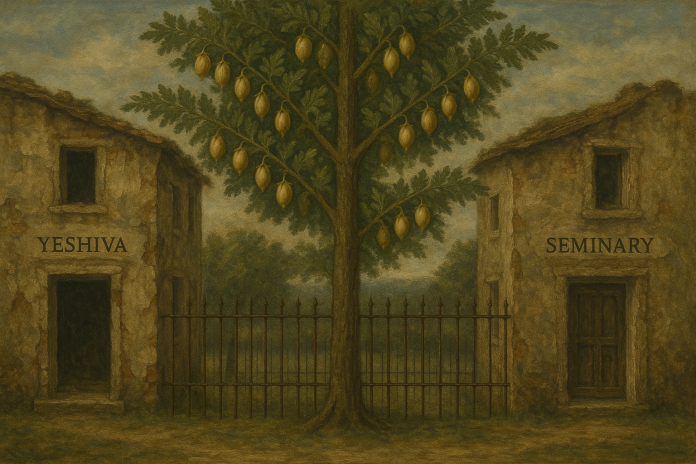
It so happened, due to a funny quirk from the Holy One Blessed Be He (“God has a great sense of humor,” my mother used to say) that The Beis Guberman Yeshiva for Impressionable Young Men, was located right beside the Hirschofsky Seminary for Girls Who Are Not Sluts.

A fence  separated the two schools. On the men’s side, a banner with a picture of a highly wizened rabbi proclaimed: May Your Eyes See The Guidance of Your Teachers. On the women’s side, a picture of a flower juxtaposed with the reminder: Blessed is the A woman who is not a Total Whore. 

Eliezer “Easy” Givaldenshtok was a student at Beis Guberman. Not a shining pupil, what he lacked in brains he made up in simplicity. He was always in the study hall when studying was expected, if not learning, then at least trying to learn. He did not partake of the evils that other yeshiva students did, such as smoking, or getting a driver’s license, or, most heinously of all, partake of pornography.

When it came time for his match to be made, it was his purity of heart that was highlighted. “Easy will make a great groom, the Mashgiach extolled. “His heart is as pure as chicken soup broth.”

Sheindel “Sheindy” Blumenhoff was a student at Hirchofsky’s. She knew all about babies, since she’d been taking care of her 13 siblings since she was old enough to walk. When it was time for her to start getting her period, her mother had read her a book called “Becoming You” that had a picture of a girl smelling a flower on the cover. It talked about periods, but not about reproduction or sex. She learned about pads, but not tampons, because tampons are too similar to dicks and we don’t want anyone getting off on their tampons.

Easy learned about sex from the Torah. He learned that it was like putting  a paintbrush in an inkwell. He learned that there was a normal way and abnormal way to do it. He learned that if he was very pure of heart he would not have any nighttime emissions, just like our forefather Jacob didn’t. 

In order to maintain purity of heart and camp, it was important to never refer to sex as sex. They used euphemism instead. It was “arrival”. It was “servicing the bed”. It was “ritual bath night”. He learned that it was an act that one shouldn’t do too often, like chickens do; and that ejaculation automatically made you impure – but that when done right was actually a very holy act.

When it was time for Easy to get engaged to Sheindy his parents gave him a choice – would he like to marry her, the first he’d ever met, or date more women? Easy was torn. On one hand, this woman was a woman. On the other hand, the more women he’d date, the more information he’d gain, such as which hotel lobby served the best coffee. He was given full freedom and zero information to make a decision. And make it he did. He would choose Sheindy as his soulmate, and they would create a Faithful House Amongst the People of Israel.

Right before the wedding, Easy had several meetings with his Chosson teacher. This was a rabbi who taught grooms everything they needed to know about being a married man, which primarily consisted of identifying different shades of period blood and counting days until his wife was ritually clean again. For, every month when a Jewish woman bleeds, she must wait until her period ends, wear white underwear and probe herself twice a day with a white cloth for seven days, and then go to a ritual bath. If she found any blood at all she had to restart her seven day count. If she had doubts she would need to send her underwear to a rabbi for review. The good news was that being with your wife on ritual bath night was a big Mitzvah – a truly worthy deed.

His teacher didn’t just limit him to the laws of Blood and Baths, although that was the bulk of it. He had other advice too: don’t argue with your wife. It’s like arguing with a toddler. When you’re doing the act, don’t rawdog it. Use a lubricant, like Vaseline. And just to make sure, the teacher had asked, avoiding eye contact and feeling deeply uncomfortable, Easy did know what happened on wedding night, right? (This was the part he hated most about his whole Chosson teacher job, the sex bit.)

Easy assured him that he did. 

And so, on the eve of his wedding, having never touched a woman before, Easy applied his knowledge of years of Talmudic study and preparation for this holy moment by slathering his dick with Vaseline and jabbing it at Sheindy’s navel.

Months passed. Sheindy remained barren, like our foremothers. They were not blessed with a baby, despite trying as hard as they could. Easy prayed harder. Sheindy cried to the creator of the universe. Oh why was God testing them so? It was time to do more manmade efforts. Although salvation ultimately comes from The Compassionate One, sometimes His messengers can even be secular Jews who have gone to medical school. They went to a fertility doctor. He examined the bruises on Sheindy’s stomach. He asked a few pointed questions. And he proceeded to explain to them a very horrifying set of behaviors that no holy person should ever have to even hear about. 

“So you’re telling me Rav Shach puts his appendage inside his wife’s lower mouth?” said Easy, using the correct biblical terminology. 

“At least 12 times,” the doctor reassured him. With great trepidation and feeling of deep impurity, Sheindy and Easy went home to give it a try. 

But alas. Despite doing it the right way, several more months went by and not a single baby boy had presented itself. Easy was even willing to have a girl at this point. Back to the doctor they went. 

He asked a few more questions. He probed and prodded, figuratively and literally. And he came to the root of the issue. Sheindy’s cycle was a bit shorter than average, and her bleeding a little heavier. Thus, by the time she had finished bleeding and counting clean days she’d missed her ovulation window.

It was time to combine the wonders of modern medicine with ancient Jewish wisdom. “If you refuse to have sex with your wife for over two weeks after she gets her period,” the doctor explained. “She’ll need to be artificially inseminated.” Easy and Sheindy wondered why Hashem would possibly make things so difficult for them, financially and emotionally. But they resolved to grow from these challenges and to purify their hearts and souls through the process. 

The next problem arose. Normally you’d just masturbate into a cup and let the in-vitro process unfold from there. Unfortunately, the Torah prohibits masturbation, it’s the grave sin of spilling seed, and it’s what got Onan killed in the bible. The workaround they devised was as follows: Easy and Sheindy would have sex in a halachically permissible manner (missionary at night with the lights off under a blanket, obviously). Then Sheindy would rush over and have them remove the sperm from her body to use in the procedure. Eyebrows were raised at the non-sterile conditions that sperm would be exposed to. But they insisted. These were their deeply held beliefs at stake here. This was the word of God they were following. And the clinic eventually complied. 

The verse says “seven times the righteous man shall fall and get up”. Hashem tests his most devoted subjects more, to ensure they are faithful. And so it was, after this third challenge and much heartache, Hashem finally blessed Easy and Sheindy, the way he blessed the biblical Rachel and Rebecca. And he delivered a double blessing, as the verse says “I shall double your crop in the sixth year”. In a remarkable act of grace that was definitely not related at all to in-vitro fertilization practices, Easy and Sheindy were blessed with twins. 

A boy and a girl. So much joy. They had leapt ahead and made up for so much lost time. Even though they were already aged 21 and 23 respectively, they had caught up to their friends. 

The sabbath before the circumcision, they had a party, as is tradition, called “Hello Male”. Amidst the shots of cheap whisky and ruggalach, the assembled men made sure to partake of chickpeas, whose circularity, the Rabbis tell us, remind us of the circle of life.

Easy sat at the head of the table, glowing. Sheindy peeked out from the kitchen, also glowing, from happiness but also from heat. Their eyes met. A bright future awaited their family, and they imagined with joy in their hearts their children growing up into God fearing servants of the Holy One.

They couldn’t wait for the day when their offspring in turn could attend Beis Guberman and Hirschofsky’s.

The circle of life strikes again.

Current Weather in Hell

Hell
snow
33.7 ° F
33.7 °
29.8 °
64 %
2.9mph
75 %
Fri
34 °
Sat
31 °
Sun
31 °
Mon
29 °
Tue
27 °

Even More Freidom

Deconstructing Zionism

I have been on a journey of deconstructing religion for the last 9 years, and this site...

Kriah

The worship of Israel as a state, especially by Jews abroad, is a recent invention. Not even...

Genesis and The Big Bang – Extra NSFW

In the beginning, God created the heavens and the earth. And water. And light. And trees. And...

Systemic Trauma

Why must drag our next generation through the dregs of the holocaust? So that it doesn't happen again?...

Sefira, Baby

Rabbi 1: Summer is coming, brace yourself. Rabbi 2: oy vey, summer? People have way too much fun...